Ask anybody who's lived in Boerne more than a year to dig a hole for a rosebush. They'll laugh. You get maybe six inches in, and the shovel stops dead with a clank you can feel in your elbows.
That clank is a big deal for us. When somebody out in Bulverde or Spring Branch calls about a paver patio, the rock under their grass is honestly the first thing on our minds, before colors or patterns or any of the fun stuff. Two patios can look exactly alike in photos, one on a flat lot in Schertz or Cibolo east of I-35. What it took to build them? Not even close.
In essence, this post is about the dirt. Or the lack of it. If you're planning a patio or hardscape project out here, this is the stuff worth knowing first.

What's Under the Grass: Caliche and Shallow Limestone
Most of this part of Texas is limestone underneath. Topsoil runs thin. On some lots in Fair Oaks Ranch, we've found three or four inches of dirt and then nothing but rock.
Then there's caliche, which sits in between on plenty of properties. If you haven't met it, it's that pale, chalky layer that looks like somebody poured old concrete under your yard years ago. Its basically soil glued together with calcium carbonate. Bone dry, you can barely get a pick into it. Soak it for a week and some caliche goes soft and crumbly on you, and that's the problem.
In practice, that changes a patio project in a few ways. Digging takes heavier equipment. A crew in a newer San Antonio subdivision might cut the sod and dig with a mini excavator; we're often hauling in a rock breaker or a saw. That's real time, and yes, it shows up in the price. We'd rather tell you that at the consultation than halfway through the job.
The ground also isn't consistent from one end of the yard to the other. You can have solid rock under one side of the patio and a pocket of dark clay under the other (clay loves to settle into the low spots between ledges). Clay swells when it's wet and shrinks back in a drought. Rock doesn't budge. Put pavers over both without fixing that and give it a couple summers. One side sinks.
And no, we don't set concrete or pavers straight on caliche just because it feels hard. People ask about it all the time. It's hard until it isn't.
Solid limestone is great to build on once you get down to it. We just need to know where it is and make the base the same everywhere.
That Big Rock in the Backyard
Almost every Bulverde or Spring Branch property we visit has one. A shelf of gray limestone poking up out of the yard, usually right where the homeowner pictured their patio.
You can take it out. Smaller outcroppings break up and haul off without much drama, or we can cut them down flush. A big ledge is another story. It can eat a real chunk of the budget, so it's better to know early.
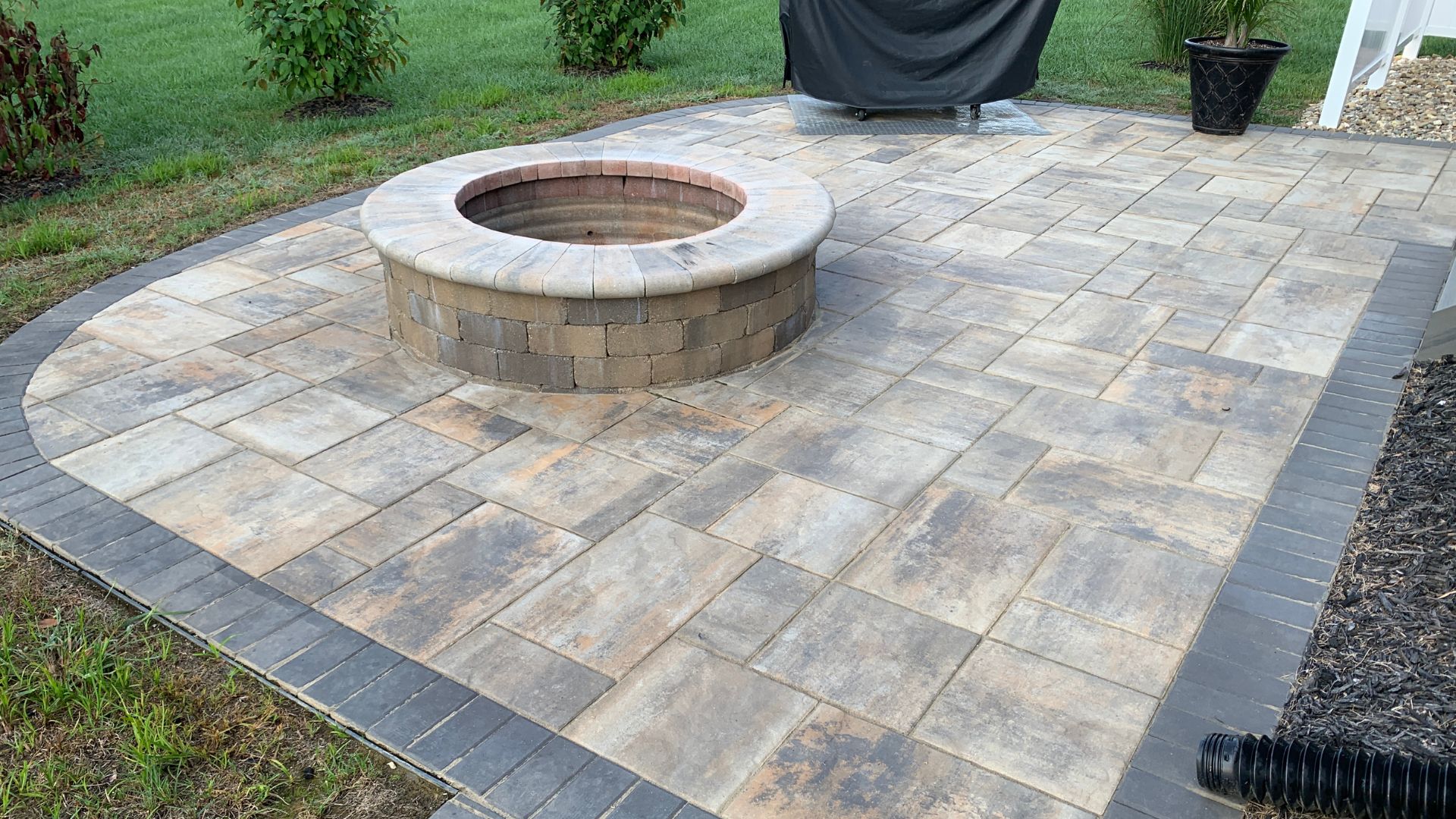
You can also just move the patio a little. Slide it four feet over, give it a curved edge, or break it into two levels with a step in between. Hill Country yards tend to look better that way anyway. A perfect rectangle can look a bit out of place next to all that native stone.
Or (our favorite) you use it. We've built seat walls right up against natural ledges, and an outcropping makes a terrific backdrop for a fire pit. Whatever comes out of the dig can get stacked into planting beds or a low border, so the rock stays on the property where it belongs.
Which way to go really depends on you. Three kids and a twelve-seat table? Flat square footage wins. If it's just the two of you and a couple chairs facing the sunset, maybe that boulder stays.
Water, and Where It Ends Up
Nobody thinks about this one until the first big storm. We'll go all summer without a drop, then the sky opens and dumps three inches before dinner. In deep soil a lot of that would soak in. Out here it hits limestone and caliche and just... keeps going. Downhill, until it finds something low.
Too often that's the patio. Or your foundation.
So, every patio we build gets a slight pitch away from the house, somewhere around an eighth to a quarter inch of drop per foot. On a lot that already tilts toward the back door, that's sometimes not enough on its own. Then we're regrading or building a short retaining wall or seat wall to steer water around the sides.

Hillside lots add a wrinkle. The water isn't only yours. It's coming off the slope above you, maybe off the neighbor's place, and in a hard rain it'll sheet right across the pavers. A shallow swale, a French drain or a channel drain on the uphill edge usually takes care of it.
We get asked about permeable pavers a lot too. They're good products! But they work by letting water down through the base and into the ground, and if there's a slab of limestone twelve inches down, the water's got nowhere to go. It can still work. It just needs an outlet designed in from the start.
One more, and it's a boring one: gutters. A downspout dumping right onto the edge of a brand-new patio will cause trouble sooner or later. We check where yours empty and pipe them past the patio if needed.
Parts of Comal and Kendall counties also sit over the Edwards Aquifer recharge or contributing zones, and plenty of neighborhoods put their own limits on how much of a lot you can cover. Handling that paperwork is just part of how we work, so you aren't stuck sorting it out.
How We Build the Base Out Here
This is where the money really goes, even though you'll never see it once the pavers are down.
First, we find the rock. A probe bar, a few test holes, sometimes just a shovel and some patience. Then the crew digs the whole area to the same depth. On a Hill Country lot that means pulling out clay pockets and soft caliche and knocking down any high spots of rock that would leave the base thinner in one place than another.
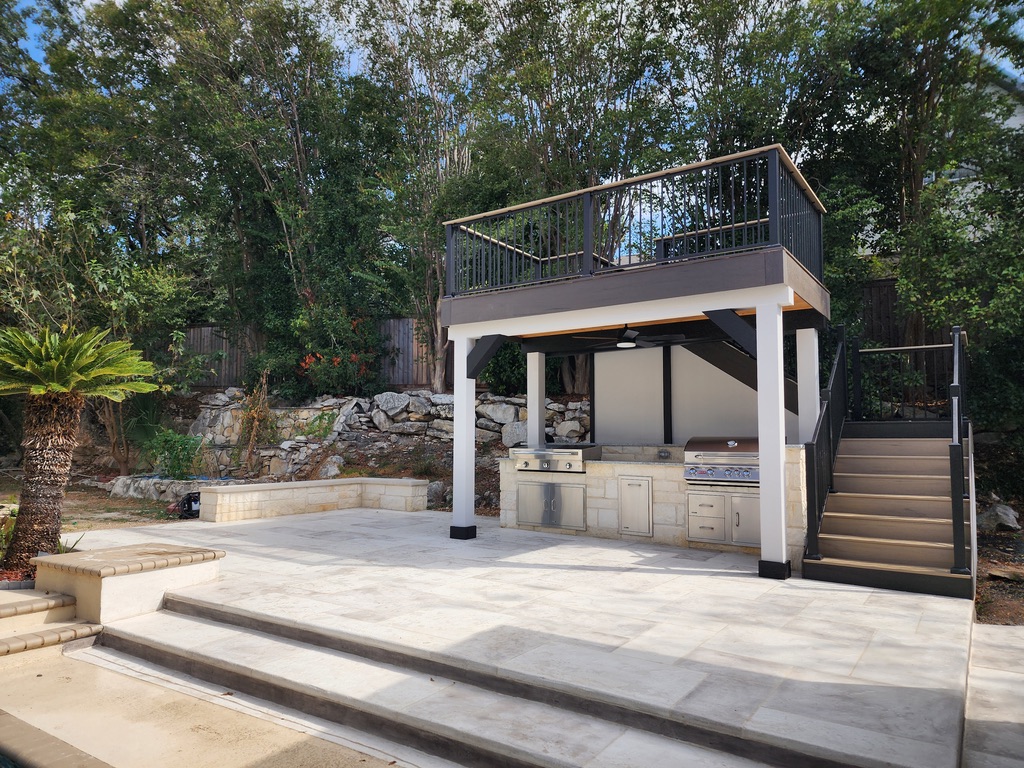
The base goes back in a few inches at a time. We use crushed limestone road base (the same flex base you see on TxDOT jobs) and run the compactor over every layer before the next one goes on. Dump six inches in at once and pack the top, and you'll get soft spots later. The drainage slope gets built right into the base, not faked in the inch of sand at the very end. Then edge restraint, which matters more than folks think on any patio that isn't dead flat.
Every town has its own personality.
In Boerne it's usually thin soil, lots of rock, and big old live oaks we must dig around carefully. A lot of neighborhoods there have HOA architectural review, so plan on a little lead time.
Bulverde lots tend to be bigger and more open, and water running across an acre of pasture adds up fast. We probably spend more time on drainage there than anywhere.
Up in Spring Branch, especially closer to the Guadalupe and Canyon Lake, lots get steep. Stepped patios, retaining walls, sometimes a deck in the mix.
Pavers, Natural Stone, or a TPC Overlay?
We install concrete pavers and natural stone like flagstone and cut Texas limestone, and all of them do fine out here when the base is right. We also specialize in TPC overlay patios, which a lot of homeowners don't know is an option.
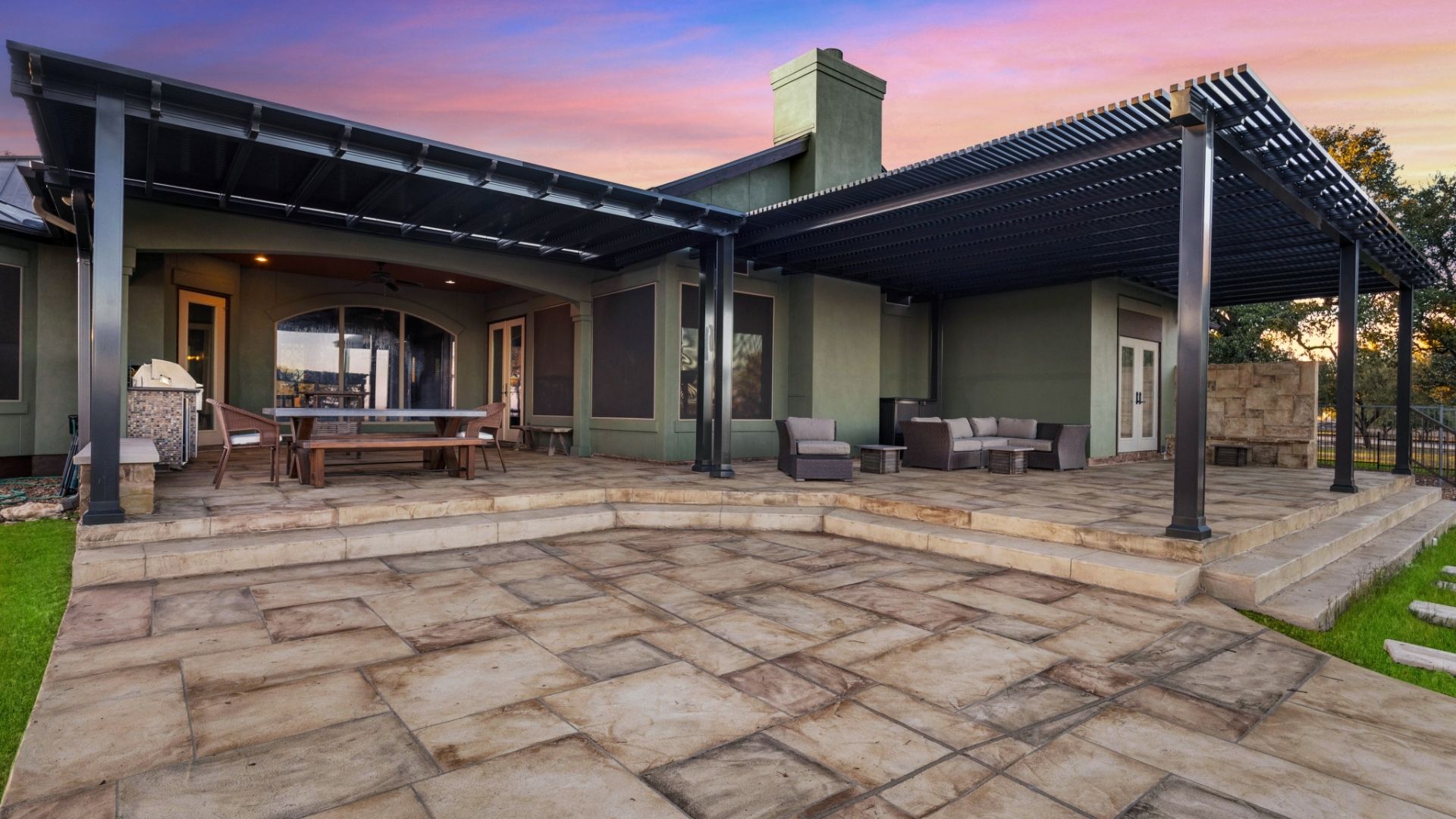
If you've already got a concrete slab that's structurally sound but tired looking (stained, a few hairline cracks, just plain gray), an overlay lets you put a finished surface over it instead of tearing it out. On a rocky lot where every bit of digging costs money, skipping the demo and excavation can make a real difference. We'll look at the slab first, though. If it's heaved or badly cracked from moving soil underneath, an overlay won't fix that, and we'll tell you.
One tip from experience, whatever you pick: lighter colors are a lot kinder to bare feet in August.
Sometimes a Deck Is the Better Call
We'll be straight with you here. If your yard falls away behind the house, a patio there means trucking in a lot of fill and building tall walls to hold it all in place. Add that up and a custom deck on footings can come out cheaper, and you keep the view.
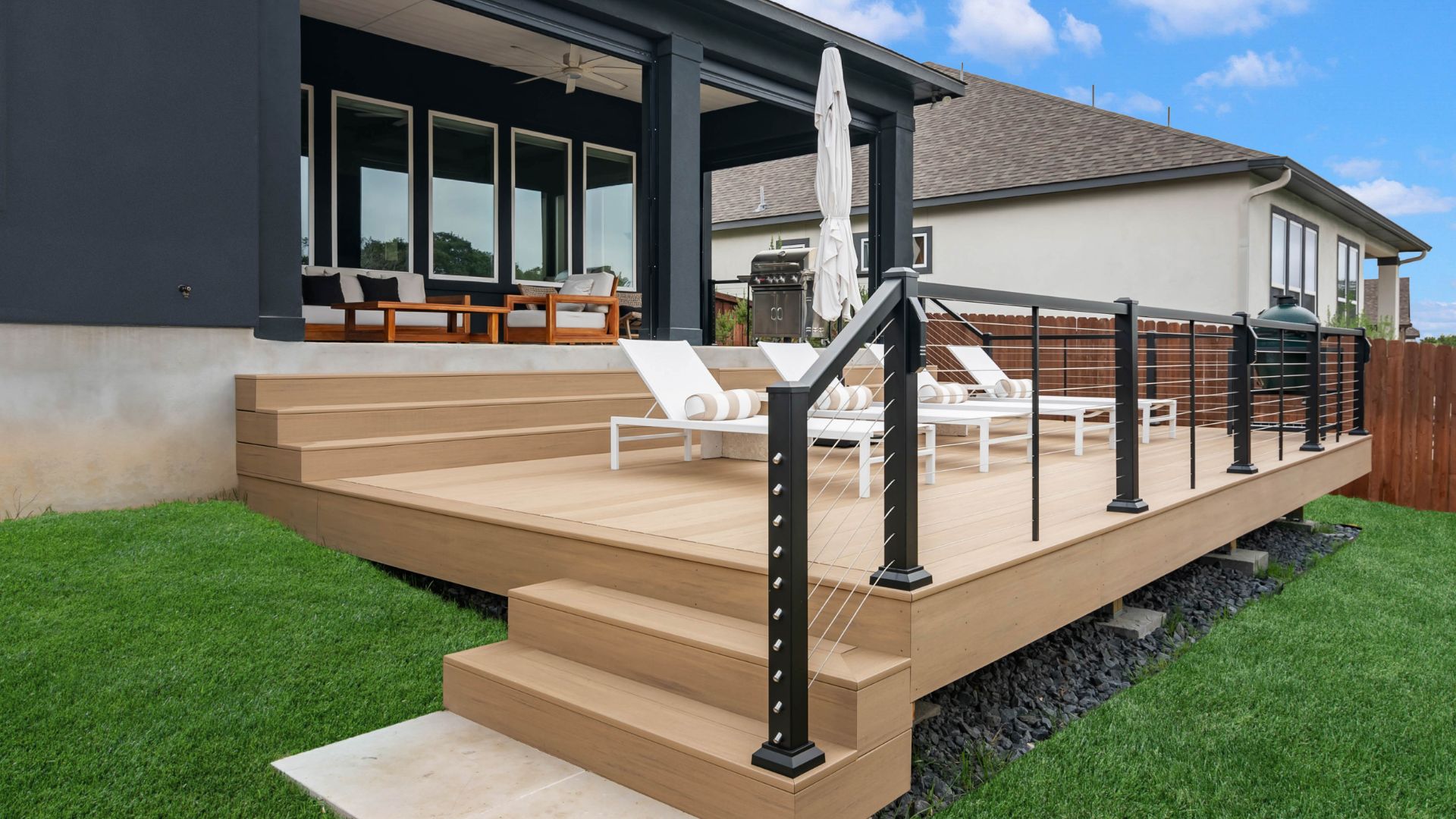
Decks are easier on drainage too. Rain goes through the boards or off the edge, and the ground underneath stays pretty much how it was.
Plenty of what we build in the Hill Country ends up being both. A deck off the kitchen, steps down to a paver or overlay patio, maybe some shade on top from a pergola or a covered patio. Flip through our photo gallery to see how that plays out on real lots around here.
Start With the Ground
The rock, the slopes, the oaks. That's why people move out here in the first place. It's also why a patio that'd be perfectly fine in a flat subdivision can crack or hold water on a lot in Spring Branch. Build it for the ground it's sitting on, and it'll outlast the grill, the patio furniture and probably the paint on the house.
We always start by walking your yard with you, whether you're leaning toward pavers, natural stone or a TPC overlay. Want us to come take a look? Book a free design consultation or give us a call at (210) 702-3223. Still in the daydreaming stage? Our free design guide is a good place to start, and the FAQ page covers a lot of the usual questions. Not sure we come out your way? Here's our service area list.
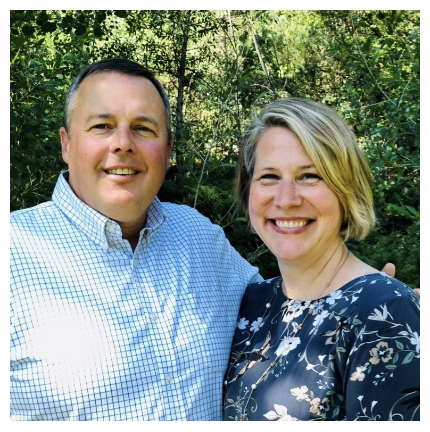
Neal & Rebecca Neathery – owners Archadeck of San Antonio